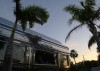



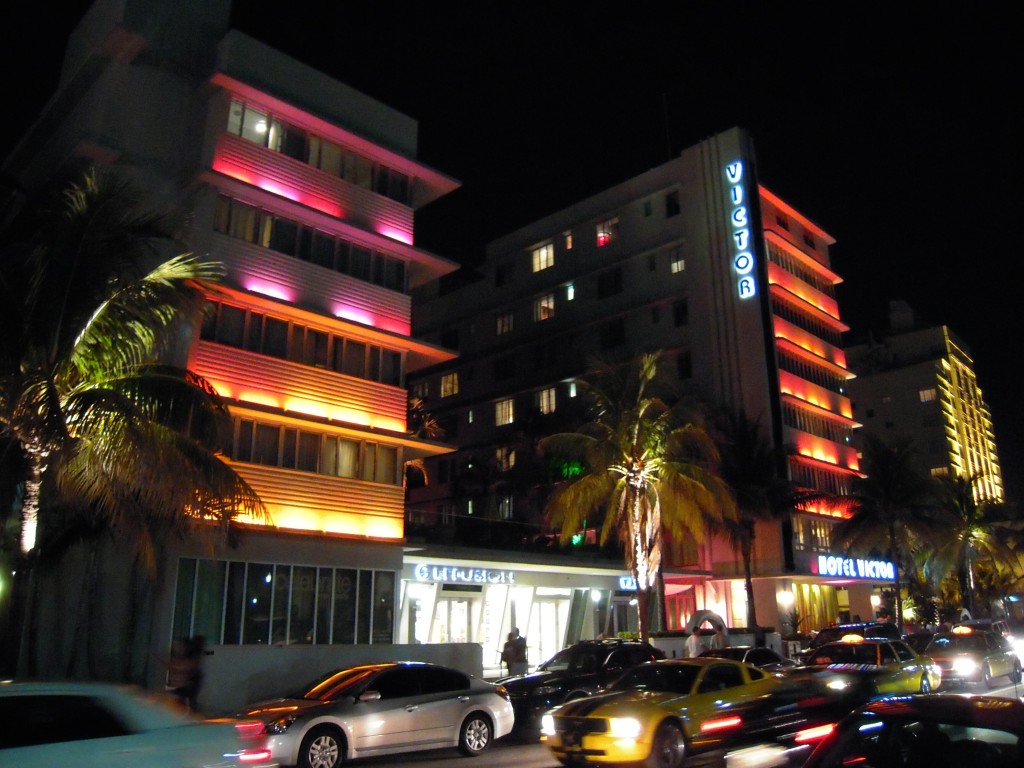
Ocean Drive, South Beach, has enjoyed a renaissance. The Victor Hotel (1937) was designed by L. Murray Dixon.

The Colony Hotel (1935) by Henry Hohauser.
Surrounded by curving white lines, steel balustrades and porthole-shaped windows, I could easily imagine I’m aboard an ocean liner steaming out to sea. After all, I’m in Miami, the world’s largest cruise port. Instead, I’m on the roof-top Spire Bar of The Hotel of South Beach surrounded by the best in Tropical Art Deco.
With over 800 registered buildings crammed into the 2.6 square kilometres bounded by the Atlantic Ocean, 23rd Street, Lenox Court and 6th Street, Miami’s South Beach neighborhood is home to the world’s greatest concentration of Art Deco architecture. The stylish, neon-lit hotels are the perfect backdrop to the nonstop party that is South Beach.
It’s hard to believe these delightful buildings weren’t always appreciated. Years ago as an art history student, I wandered South Beach, dodging panhandlers and trying to find a place to eat. The area was derelict and ‘cocktails’ were being swigged from brown paper bags, not martini glasses. The glorious Art Deco hotels were boarded-up shacks, their pastel hulks peeling from salt breezes, collapsing under the sun. The decades hadn’t been kind to South Beach; in fact it looked ready for the wrecking ball. Most people thought it couldn’t happen fast enough.
What I didn’t know then was that a group of volunteers was already working to document and raise awareness of Miami’s beleaguered architecture. Barbara Baer Capitman, urban visionary and former interior designer, formed the Miami Design Preservation League (MDPL) in 1976 and an annual Art Deco Weekend festival was launched to draw visitors to the area. But the district’s population was comprised mostly of the elderly, many living below the poverty level, effectively powerless. Despite influential supporters like Andy Warhol, whose 1980 visit received wide media coverage, developers still circled South Beach with bulldozers. Just a month after Warhol’s visit, the Boulevard Hotel was demolished followed shortly by The New Yorker, mourned by many as one of Henry Hohauser’s best works.

Symmetry, a central skyscraper-like panel and ‘eyebrows’ – the Chesterfield Hotel has it all.
The neighbourhood had an unlikely saviour. When the TV series Miami Vice stormed the world stylistically in the mid-80s, the sight of Armani-clad actor Don Johnson cruising Ocean Drive as detective Sonny Crockett inspired a fresh wave of tourists. No matter that the hotels were in such decrepit shape that false fronts had to be erected for those television scenes. The new attention, along with hard-won protective legislation, saved the buildings from demolition. The South Beach Art Deco District is now on the National Register of Historic Places, the only 20th-century neighbourhood to make the list.
What is Art Deco style? Born in the Jazz Age, debuted at the Exposition Internationale des Arts Décoratifs et Industriels Modernes in Paris in 1925, Art Deco was a completely new style based on machine-inspired forms. The new aesthetic was applied to everything from jewelry and housewares to textiles and architecture and remained hugely popular throughout the Depression.
How to spot Art Deco buildings: Look for overall symmetry, curved shapes, ziggurat (stepped) gables, eyebrows (brise soleil) over windows, elements placed in threes, the use of modern materials like glass blocks, chrome, Vitrolite and neon. Though Depression-era budgets meant that the Miami Art Deco hotels are relatively small, they were inspired by the skyscrapers of New York. A center panel or section drawing the eye upward is a good indication that you’re looking at an Art Deco building.

No purpose for the pink neon sections except style and pleasure.
With its pastel tints, zippy modern shapes and general mood of adventure created by themes of travel and transportation, Art Deco architecture reflected the future-embracing optimism of the era between world wars. Exotic accents hinted at the allure of foreign lands as well as the archaeological craze that followed discovery of Tutankhamun’s tomb.
Art Deco was a true international style and outstanding examples can be found around the world. Miami’s version of Art Deco is unique because architects used local imagery – stylized palms and ocean liner motifs – to create a Tropical Deco style that reinforced the image of Miami Beach as a seaside resort. The Colony Hotel, at 736 Ocean Drive, was one of the earliest designed in this style by Henry Hohauser, its 1935 lobby swimming in sea-green Vitrolite.
In the era of transatlantic crossings on glamorous ships, cross-continental travel on luxury trains and excitement created by recordbreaking flights by Charles Lindbergh and Amelia Earhart, the technology of transportation was a thrilling Art Deco motif. The signage finial of The Hotel, formerly the Tiffany (by L. Murray Dixon, opened 1939), replicates the dirigible mooring mast originally atop the Empire State Building.
Gazing at the ocean from the Spire Bar, surrounded by curving white lines, steel railings and porthole-shaped windows, it’s easy to fantasize you’re aboard a cruise ship. Just blocks south, floating hotels much larger than those on shore sail from the Port of Miami. The blast of their horns, evoking shipboard adventure and romance, is the perfect soundtrack to a weekend spent exploring Miami’s Art Deco architecture.

Haddon Hall (1941) is a supreme example of streamlined style by L. Murray Dixon.
Art Deco Welcome Center: 1001 Ocean Drive, Miami Beach. (305) 531-3484
For more on Art Deco Weekend Festival (January) and other activities of the Miami Design Preservation League, see www.mdpl.org.
The MDPL also conducts an Art Deco Academy and Tour School twice a year (spring and fall). For information, call (305) 672-2014
For more trip tips and inspiration, see Miami and Beaches.

The Hotel of South Beach, formerly the Tiffany (1939) by L. Murray Dixon.

The metal spire was inspired by the dirigible (zeppelin) mooring mast originally on top of the Empire State Building in New York City.

The porthole window and white ‘deck’ lines of The Hotel of South Beach (formerly the Tiffany) give the hotel the feel of an ocean liner.

A decorative wave pattern on the Whitelaw Hotel = Tropical Art Deco.

Ocean Drive, South Beach, Miami.

South Beach, Miami, is the perfect combination of cultural and beach vacation.
All photos by Lesley Peterson.