
ArtSmart Roundtable: mosaics of the Basilica of San Vitale, Ravenna
Time for the ArtSmart Roundtable, a fun and fabulous group of bloggers sharing the double passion of travel and art. Each month, members publish on a particular topic; this month it’s Art Worth Traveling For. Be sure to scroll down for links to my colleagues’ unique perspectives. Now, the brilliant 6th century mosaics of San Vitale, Ravenna, Italy–a destination drawing pilgrims, art historians and lovers of beauty for nearly a millennium and a half.
In all my Italian travels, why did I leave visiting Ravenna until last fall? It was always slightly out of the way, easy to postpone. My art history textbooks had given Ravenna’s mosaics–particularly those at the Basilica of San Vitale–a huge buildup. I had a gut feeling that Ravenna and San Vitale might spoil me for anything that followed. When I finally felt ready, the experience was more profound than I’d ever imagined.
San Vitale is one of the most important examples of early Christian Byzantine art and architecture in western Europe, with extravagant Byzantine mosaics the largest and best preserved outside of Constantinople.
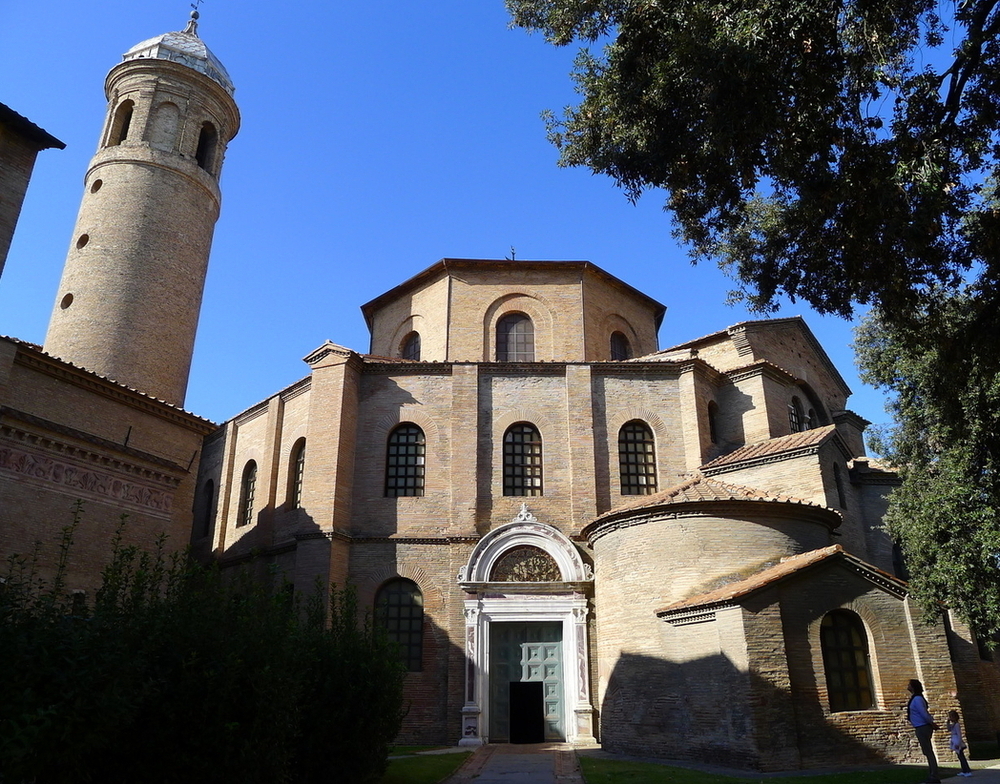
What does Byzantine mean? Headquartered in Constantinople (present-day Istanbul), the Byzantine Empire, or Byzantium, was the Roman Empire in the east. While the Western Roman Empire collapsed in the 5th century AD, Byzantium thrived for another thousand years until it fell to the Ottoman Turks in the 15th century.
Under Justinian I (born c. 482, Emperor from 527-565 AD), the Byzantine Empire regained much of the Mediterranean territory lost to the Ostrogoths, including Rome. In 540, they reclaimed Ravenna, bringing all the opulence of the Byzantine court to the city. San Vitale is the only major church from Justinian’s reign to survive in almost perfect condition and demonstrates the apex of Byzantine power, wealth, technology and artistry.
In portrait panels on either side of the apse, Justinian and Empress Theodora eternally attend mass with their retinues.
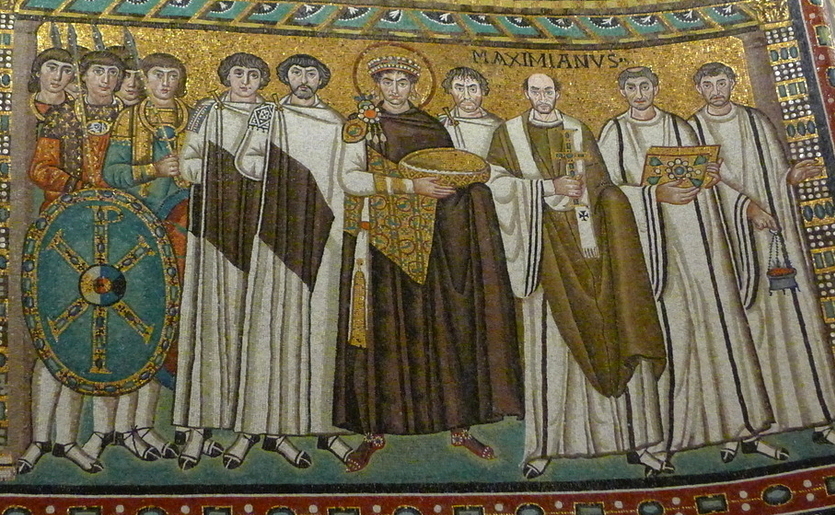
Justinian’s determined gaze and five-o-clock shadow attest to masculine power and vigorous governance.
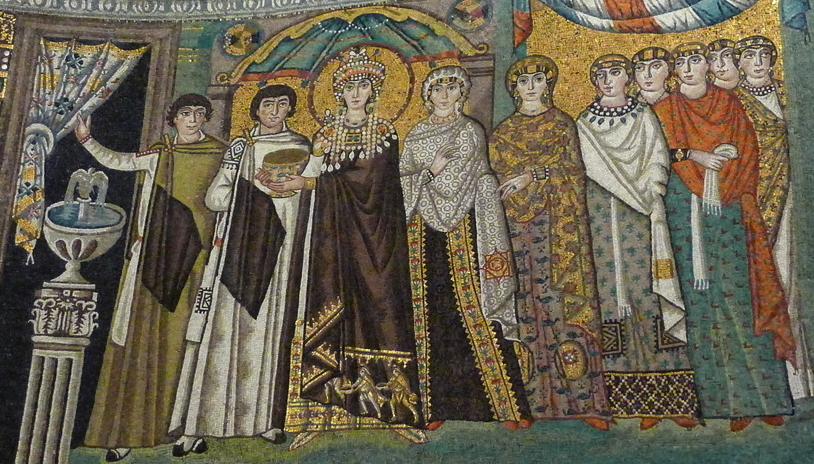
Theodora. Gold and glass make garments shimmer like silk. Skin is realistically modeled with matte marble.
Though there are eight sites in Ravenna on UNESCO’s World Heritage list, I couldn’t tear myself away from San Vitale. I finally wandered out, hours later, too overwhelmed to look for or at anything else. I would feel like that for weeks. On the drive back to Venice, I gazed out the window as a flock of ducks burst out of autumn-gold marsh, flying low between the lagoon and sky. It struck me that by covering the basilica’s interior with birds, flowers and grasses of the Adriatic landscape, San Vitale’s master mosaicists were telling us that heaven is here. And eternity is now.

Biblical stories and Christian themes are set on a lush landscape of flora and fauna found around Ravenna and the Adriatic coast.

For those who remember to look down, a scallop shell guides pilgrims to trace the spiritual path of a labyrinth.
The ArtSmart Roundtable:
Erin - Wait, You Want Me to Go to Liverpool to See Art? http://www.a-sense-of-place.com/?p=3350
Christina – A Day in Medieval Europe at the Cloisters, New York City http://daydreamtourist.com/2013/03/04/medieval-europe-at-the-cloisters/
Kelly – Richard Serra’s Band Sculpture http://www.travellious.com/artsmart_roundtable_richard_serras_band_sculpture
Murissa – Art Worth Traveling For in Rural Italy http://www.thewanderfulltraveler.com/?p=4033
Jeff – Traveling for the love of art http://www.eurotravelogue.com/2013/03/art-museums-worth-traveling-for.html


The mosaics are so well preserved and colourful for its age. The green is so vibrant. It seems there is cross over in our posts this month Lesley.
Hope all is well.
Murissa
In the words of Liz Lemon, “I want to go to there.”
SOOOOO jealous that you saw San Vitale! I swooned in every art history class that featured it. Did you know that in the Justinian mosaic, he had a huge opal set in the brooch?
I didn’t know about the opal:o but I can just imagine Justinian and Theodora walking around, draped with silk and dripping with all those huge pearls. Justinian actually appears to be moving, the pearls seem to swing out from his ears. The figures are life sized and the skin modelled with realistic tones, just phenomenal craftsmanship. And stewardship, and luck, that this has lasted since the sixth century.
Ravenna has been on my short list for a very long time, since I learned about it in school really. I love mosaics! Hopefully I will get there on my next trip to Italy. Great detailed post, Lesley!
Ravenna would be a great trip to take the kids on, Jenna! Even the youngest understand piecing together a puzzle or a picture and they’d love spotting all the animals and ducks on the walls at San Vitale. Ravenna seemed a really clean and relaxing town, full of university students and people on bikes.
Great choice Lesley! Ravenna is definitely the #1 world art destination!
I am blown away by your amazing pictures! You’ve captured the entirety of the space which is so overwhelming, as well as the brilliant mosaic colors! I’m happy to hear you had such an enjoyable and profound experience there!
After seeing all the churches of Ravenna, I remember trying to get back to San Vitale to see it one more time, even if it meant another 50Euro ticket (which was a lot since I was in school at the time!). Didn’t make it back in time; I guess I have to return, just as you have back to see the rest of the Byzantine capital!
It’s easy to imagine how some people have made Ravenna their life’s study. I could spend a few months just sitting in San Vitale alone. Changing light over the course of the day creates a completely different experience, from moment to moment, almost like watching a movie. Some of the windows are thin sheets of (I think) alabaster, creating an intense golden glow. I really must get back there!
An inspiring post. I never imagined a building’s interior could billow but San Vitale’s dome surely seems to based on your images. Beautiful.
What absolute glorious mosaic scenes bathed in golden light. Theodora and Justinian seem almost life-like. The photos catch the exquisite detail, the dome breath-taking.
Of all the time I lived in Italy, a weekend in Ravenna was one of the most memorable trips. San Vitale is amazing to experience as are the many other churches, some out of the way from the center of town. Unfortunately, my visit there was pre owning a digital camera – the photos I have don’t do it justice. Happy to relive it here.
Oh, I hear you, Monique. I was very late to leave film for digital. Now that I can take **thousands** of pics per trip, I haven’t looked back:D
This is a beautiful meditation. It’s wonderful to see how well preserved all the mosaics are — the colors are still vibrant.
It would be difficult for me to leave as well but I know after I while, I’d be visually overloaded and not be able to fully appreciate it.
I’ve still not been to Italy and now I have Ravenna to put on my list. Thanks, Lesley. I’ll check out the other ArtSmart posts.
I too was blown away by the mosaics of Ravenna, both in the byzantine chapels and around town. Even the mosaics of the street signs, or door mats with little mosaic flip flops in them, or mosaic pigeons in windows, just astounded me.
Great post! I love your art round table. I’m having fun visiting all the website today.
Thanks for dropping by, Sara! Wouldn’t it be a dream come true to take mosaic classes in Ravenna?
My husband is an artist and we’ve been debating between mosaic classes in Ravenna or glass blowing in Venice (Murano). Oh to dream…
Wow the detail in the mosaic is incredible.