




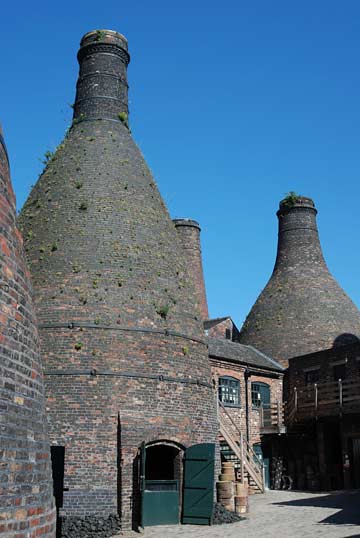
Bottle kilns at Gladstone Pottery Museum.
One of my favorite art and travel experiences was to the Staffordshire Potteries in the UK. The Staffordshire Potteries are centered around Stoke-on-Trent in Staffordshire, England. Once the industrial heart of England, much of the area now has a rural feel with over 30 pottery-related sites snugged in a pretty landscape.
Though I was there in February, my memories are warm: friendly people dedicated to keeping the region’s legacy alive, cozy fireside meals in a medieval moathouse, a sense of wonder that such beauty and invention could take place where, for much of history, mere survival would have been miracle enough.
Rainsoaked, mud-filled hills. Cold ground, you’d think, for big dreams. Nevertheless the Potteries became a world centre of ceramic production in the 17th century due to local availability of coal, lead, salt and clay. With imagination and perseverance, these rough materials were transformed into objects both useful and beautiful.
One of the greatest innovators in British pottery was Josiah Wedgwood (1730-1795). A fourth generation potter, fatherless at 9, Wedgwood experimented tirelessly to develop new types of pottery (the famous Queen’s Ware, Jasper Ware and more), industrialized the production of pottery, created new methods of marketing and worked to improve local roads, canals and working conditions. Eventually, the family’s money and interest in geology and natural history would fuel Josiah’s grandson Charles Darwin’s pursuit of the origin of species and theories of evolution.
The Stoke/Stafford area is a true adventure in art and history. I’d love to return and wouldn’t hesitate to go in winter. Staffordshire’s twin fires of hospitality and creativity are well ‘stoked’ and provide ample warmth any time of year.
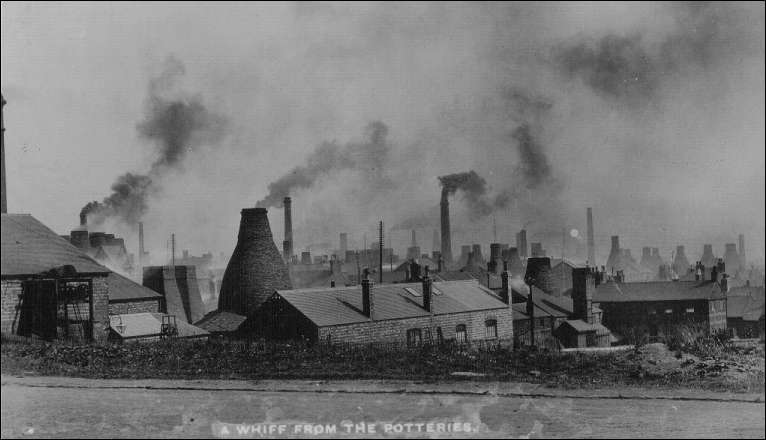
There used to be over 2000 bottle kilns dotting – and polluting – the Staffordshire landscape.

Pigtails and flared coats are always in fashion at the Wedgwood Museum.

Demonstrating the throwing of Wedgwood’s distinctive Jasper Ware at the Wedgwood Museum.

Another pretty Wedgwood pattern.

February snowdrops and holly in Staffordshire, England.
Links:
The Potteries – Fascinating photo archive about the Potteries’ technology and history.
Staffordshire Tourism – Home to the Potteries, the National Forest, the Staffordshire Hoard of Anglo-Saxon gold and more.
Visit Stoke-on-Trent – Less than 2 hours by train from London, Stoke-on-Trent is the world capital of the pottery industry, home to the Wedgwood Museum, Royal Doulton, Portmeirion, Moorcroft, Aynsley and dozens of pottery sites and attractions.
In Toronto, learn more about English pottery and china at the Gardiner Museum, home to 11,000 years of ceramic art.

The heart of England is also a great cheese destination. Here a traditional Ploughman’s Lunch, with meatpie and Branston pickle in the background.

Wedgwood version of the Portland Vase, 1790, Victoria & Albert Museum.
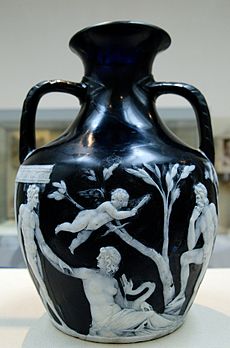
The ‘Portland Vase’, Roman cameo glass circa 5-25 AD, British Museum.